
Leading job portal Monster.com said on Monday that recruitment activities in many sectors witnessed a decline last month compared to July.

India's services sector lost momentum in July as demand was curtailed by competitive pressures, elevated inflation and unfavourable weather, a monthly survey said on Wednesday. The seasonally adjusted S&P Global India Services PMI Business Activity Index fell from 59.2 in June to 55.5 in July, pointing to the slowest rate of growth in four months. For the 12th straight month, the services sector witnessed an expansion in output. In Purchasing Managers' Index (PMI) parlance, a print above 50 means expansion while a score below 50 denotes contraction.

These funds constitute their portfolio using the same stocks and in the same ratio as found in the index. These funds simply mirror the index. So their returns are in the same line as the returns generated by the index. They will never outperform the index.

The number of dematerialised (demat) accounts - required to hold shares and other securities in electronics format - crossed the 150-million mark for the first time in March. In March, 3.12 million new demat accounts were added despite a spike in market volatility, taking the total count to 151.4 million. The milestone has come 19 months after the total number of demat accounts hit the 100-million mark, a sign that more domestic households are taking to direct equity investing.

New business received by Indian manufacturers expanded at the fastest pace since February.

The demand for professionals working in banking and insurance and production maintenance also saw the maximum dip during October.

India's manufacturing sector activities moderated in December but output remained in the growth territory, amid slower rise in sales and new orders, even as business sentiment was dampened by concerns surrounding supply-chain disruptions, COVID-19 and inflationary pressures, a monthly survey said on Monday. The seasonally adjusted IHS Markit India Manufacturing Purchasing Managers' Index (PMI) eased to 55.5 in December, from November's ten-month high of 57.6. The December data pointed to a "substantial, albeit slower, rises in sales and output", the survey said, adding that the latest quarterly reading was at 56.3, its highest since the final quarter of fiscal year 2020/21.

Interim Budget, the US Federal policy decision and quarterly earnings will be the major drivers for stock markets which may also see some consolidation this week, say analysts. Besides, investors would also focus on the trading activity of foreign investors and global trends for further cues. From the macroeconomic front, the PMI (Purchasing Managers' Index) data for the manufacturing sector is scheduled to be announced on Thursday.

'Investors don't have to worry about underperformance in passive funds, which earn market-equivalent returns.'

Smaller stocks have emerged as Dalal Street's favourites in 2023 that has turned out to be a "great year" for equities, rewarding investors with big gains, driven by optimism over the country's macroeconomic fundamentals and heavy retail investors participation. Experts said equity markets are experiencing a prolonged bull run and it is during this time that the midcap and smallcap segments tend to outshine their larger counterparts. Till December 22 this year, the BSE smallcap gauge has jumped 13,074.96 points or 45.20 per cent while the midcap index has surged 10,568.18 points or 41.74 per cent.

Hiring activities slowed down marginally in many sectors during the last month amid challenging economic conditions, according to job portal Monster.com.

India's services sector activity expanded at the strongest pace in ten-and-a-half years in October, driven by a substantial upturn in business activity amid favourable demand conditions, a monthly survey said on Wednesday. Companies indicated that a notable pick-up in new business led to the fastest expansion in output in over a decade and as a result more jobs were created, even though business confidence remained subdued due to growing inflationary concerns. The seasonally adjusted India Services Business Activity Index rose from 55.2 in September to 58.4 in October, signalling the strongest rate of growth in ten-and-a-half years.

Riding the wave of the equity market, the mutual fund (MF) industry experienced double-digit growth in Samvat 2079, concluding the Hindu calendar year close to the Rs 50 trillion assets under management milestone. After a subdued 6 per cent growth in Samvat 2078, the industry's assets surged over 18 per cent last year to Rs 46.7 trillion. Industry players anticipate that Samvat 2080 will also be a fruitful year for the asset management industry, given the strong inflows from retail investors, particularly through the systematic investment plan route.

While selecting a smallcap scheme, go with one that has a good track record and a stable fund manager.
In India, index funds are found wanting in both aspects -- long-term performance and cost efficiencies.

'We have essentially tried to set out an agenda for the next five years and it, in essence, represents the political commitment to that agenda.'

Trading in stock markets this week will be majorly influenced by the upcoming quarterly earnings from IT majors TCS and Infosys, along with global trends, analysts said. Besides, global oil benchmark Brent crude, rupee-dollar trend and trading activity of foreign investors would also dictate the movement, they said. "On the domestic front, all eyes will be on the beginning of corporate performance for the third quarter of the current fiscal year.

According to the Graded Response Action Plan (GRAP), the air quality is considered to be in the emergency category if the PM2.5 and PM10 levels continue to be above 300 micrograms per cubic metre and 500 micrograms per cubic metre respectively for 48 hours or more.

India is among the worst-performing BRICS nations along with Brazil (ranked even lower than India at 71st this year).

The coronavirus outbreak has brought a large part of the world's second-largest economy China to a standstill and its impact has been felt across industries.

Year-on-year comparison shows a 14 per cent increase in hiring activity when compared to April 2013, the report said.

In addition to regulatory actions against small and midcaps, tighter liquidity conditions are another headwind that stocks are facing this month. Market observers say advance tax outflows and capital gains-related adjustments will weigh on the markets in the near term.
Stock markets would take cues from the upcoming macroeconomic data announcements and global trends besides keeping a watch on the trading activity of foreign investors, analysts said. The last batch of the ongoing earnings calendar would trigger stock-specific action, traders said. "This week, we have to deal with macroeconomic data on both the domestic and global front.

Among the Sensex firms, ICICI Bank and SBI led the index with the maximum gains of 4.68 per cent and 3.99 per cent, respectively. Other major gainers were Larsen & Toubro, Kotak Mahindra Bank and HDFC Bank. On the other hand, Wipro and Tata Motors defied the trend and traded in negative.

Notwithstanding the ongoing decline in equity markets week after week, August has proven to be the most successful since December for initial public offerings (IPOs). In August of this year, six companies have collectively raised approximately Rs 4,269 crore through IPOs.

Business activity has fallen by a fourth of the pre-COVID levels due to lockdowns imposed by states to contain the spread of the second wave of COVID-19, Japanese brokerage Nomura said on Tuesday. However, it said the falling activity levels will have a muted economic impact and maintained its growth estimates for the year, saying the lockdowns present "downside risks". As of April 25, the Nomura India Business Resumption Index (NIBRI) registered its steepest weekly fall in over a year of 8.5 percentage points to 75.9, which is 24 percentage points below pre-pandemic normal, the brokerage said in a statement.

In the event of the BJP's poor performance in the assembly polls this year and in early 2025, Modi's hold will get further weakened because he will no longer remain the invincible electoral persona tightly controlling the machine at his disposal, asserts Nilanjan Mukhopadhyay.

rediffGURU Dr Karthiyayini Mahadevan offers advice on post-menopausal health care.

'Young investors with limited funds should ensure that investing in NPS does not crowd out their other, more liquid, investments.'
Trends in the global markets, trading activity of foreign investors and announcement of domestic macroeconomic data are the major factors that would drive investors' sentiment in a holiday-shortened week ahead, analysts said. Benchmark indices had a record-breaking rally in the past week driven by impressive GDP data. Equity markets would remain closed on Friday for Mahashivratri.

Launched in September 2013, the Conference Board Leading Economic Index for India, conceptualised back to April 1990, has successfully signalled turning points in the economic cycles of India.

'Higher inflows into these securities should lead to lower borrowing costs for the government.'

The government's increased thrust on investment and continued focus on job creation in India gives the sense of an improving job market scenario in the coming months.

A reading above 50 indicates expansion, while a reading below 50 reflects contraction.
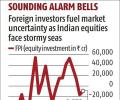
Foreign portfolio investors (FPIs) have withdrawn Rs 25,305 crore from domestic markets since September. FPIs were net sellers in the first two months of 2023, but from March to August, they purchased equities worth Rs 1.7 trillion. This selling trend has caused the National Stock Exchange Nifty Index to decline by 3.2 per cent from its September highs. FPI selling initially began in September as profit-taking but intensified due to rising US bond yields and uncertainty regarding the rate hike trajectory.

White-collar hiring witnessed an 8.6 per cent annual decline in September, following a negative trend in sectors including IT, BPO or ITES and FMCG, a report said on Monday. On a month-on-month basis, however, there has been a growth of almost 6 per cent in job postings. In September, there were 2,835 white-collar job postings, down by 8.6 per cent compared to the same month last year when 3,103 jobs were posted, according to Naukri.com's monthly 'Naukri JobSpeak Index'.

India spends significantly less on defence than could be expected from a country that faces simultaneous armed threats from two hostile neighbours -- China and Pakistan.

The Reserve Bank of India's interest rate decision, macroeconomic data and global trends will drive investors' sentiment this week, with markets hoping to continue the positive momentum after ending FY24 on a buoyant note, analysts said. In addition, the trading activity of foreign investors, the rupee-dollar trend and the movement of global oil benchmark Brent crude would also influence trading in equity markets. The 30-share BSE Sensex climbed 14,659.83 points or 24.85 per cent in the 2023-24.

The size of Reserve Bank's balance sheet increased by 11.08 per cent to Rs 70.47 lakh crore as on March 2024, leading to the highest-ever dividend payout to the government, according to the central bank's annual report. In actual terms, the increase was Rs 7,02,946.97 crore over Rs 63.45 lakh crore as on March 2023.
Macroeconomic data announcements, global trends and trading activity of foreign investors would guide momentum in the equity market this week, analysts said. Markets ended a five-week losing streak and gained nearly a per cent last week, helped by a sharp rebound on Friday. Last week, the BSE benchmark jumped 500.65 points or 0.77 per cent and the Nifty gained 169.5 points or 0.87 per cent.
 © 2026 Rediff.com - Advertise with us - Disclaimer - Privacy Policy - Sitemap - Feedback - About us - Terms of use - Grievances